The Future in Paris: By Jan Gordon 1920
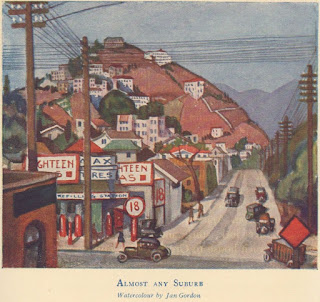
Many years ago, I bought a volume of 'The Apple of Beauty and Discord", which contained a reproduction of a woodcut by Cora Gordon of Sennen Cove in Cornwall. Today, I looked again and read an article by Jan Gordon on 'The Future in Paris', a discussion of the fading of Paris as a centre of invention in art after the end of WW1. I have transcribed the article here below.
'Since 1800 Europe has looked to France for inspiration in Art. France emerging from the throes of the Revolution began the series of developments which in themselves constituted a revolution in Art. Even though the principal leaders in some of the later developments were not French, such as Picasso, a Spaniard, Boccioni and Severeni, Italians, the whole movement from A to Z was French in character, French in inspiration, and the foreign assistants were usually of Latin origin; though some impetus was given by the oriental element contributed by the younger Jewish painters.
The question uppermost in the minds of many painters and artists to-day is: "Will France or Paris resume her ancient energy; can she continue to inspire the creative force which for one hundred and twenty years or more she has engendered"? It seems almost too apt that this upheaval brought into being, as it were, by a series of national cataclysms should be cut short by another. It seems almost too logical to happen in so illogical a world, that France, exhausted by the Napoleonic wars and finally conquered by Europe, should bring out the flower which France resurrected from the ashes can no longer nourish. Yet there are not lacking signs that this may be the case.
The French development has been, in spite of a few mitigating circumstances, a material development, and to a large extent scientific in character. In this way it was suited to and probably the outcome of the temper of the age. But now the sifting of the material has been almost exhausted: the Impressionists and post Impressionists analysing the study of light - Cezanne immersed in problems of space and of realisation, Gaugin recreating the decorative sentiment of the early Florentine painters, Van Gogh trying to fuse Cezanne and the Impressionists, Picasso seizing upon one saying by Cezanne and abstracting the expression of space from realism, afterwards combining this with the attempt to suggest concepts, the Futurists concentrating upon movements, Orpheists and Syncromistes banishing almost all representation and endeavouring to appeal to the purely abstract relationship of form and colour. It seems after the list is complete that there is nothing more to discover. The highways and hedges of Art have been explored, analyzed, tabulated. Everyone is screaming that this form of expression is the only form, like quacks at a fair each belauds his Art nostrum; the public like a bewildered yokel half believes and half is suspicious.
Now, since to a great extent the value of Paris depended on the fact that it was once the centre of this aesthetic vortex, what is to happen once the whirlpool ceases and the waters become more still? There is no doubt that much good work has been produced under this inspiration of excitement and of discovery. There must have been an almost similar mental aura sur rounding the early Italian period —in such an atmosphere the artist is stimulated and a man of talent can produce his best. But this has all been suddenly swept away, the more vital episode of the war makes the quarrels amongst artists seem absurd. The period of discovery has come to an end, experiment has changed to practice.
One sees in Paris today the effect of this change. The mental excitement and antagonism has died out and so an artificial stimulus is applied—once this poultice has grown cold, I fear that the decadence may set in. At the present moment the painters who are doing notable work are those who had established themselves before the war: Matisse, Derain, Picasso, Vlamink, Severini, Leger, Marchand, Kissling, L'hote, Gleizes and Bracke, to name some of the more prominent. The rank and file of the Autumn Salon shews a new academism growing up. Instead of clever painting aux Artistes Francais or la National there is now clever painting au Salon D'Automme. There is no longer concentration on the "realising" which Cezanne empha-sised and which shewed even in the work of the younger artists; now there is content to exploit the new styles; the dodge of Picasso or of Matisse has been adopted in place of the dodge of Simon or of Blanche.
Amongst the more advanced artists there are two tendencies. One is to push a refinement into what has already been discovered. On the whole, Cubism is more widely founded than ever it has been. A strong demand for ultra modern work has come in from the Scandinavian countries, which for the first time in the century, enjoys a comparative wealth amongst the general poverty of Europe. On the part of the keener intelligences, however, there is a tendency to retract from the most advanced positions. Picasso is at present producing most exquisite line drawings from the nude which are almost classic in vision and in style. L'hote is preaching a return to David and to Ingres.
It is like the break of a wave, part of the wave still falls forward, part draws back, and part is thrown up as spume. There are two varieties of the genus artist; the one who is genius, the other who is talented and fortunate. To the genius, the temper of his age matters little, of him, Whistler says with truth "Art happens;" but the talented and fortunate man, who does in fact provide the major portion of our best artists and to whom even 75 or 80 per cent of the masterpieces of the world are due, is peculiarly susceptible to external influence. The major part of the modern movement is composed of such. Cezanne, Van Gogh and Gaugin were dowered with true genius, but one would hesitate to say as much even of Matisse. Matisse, much more than Sargent, is the Hals of the present age.
To the genius, the attitude of the public does not matter, he is driven to expression by a mental push which he cannot resist; but to the talented man, the attitude of the public is of great importance-the talented man produces his finest work in the light of adverse criticism. Once his conscience has convinced him of the value of the work which he is producing, the fact that he is producing it in opposition to popular taste strings him up. He becomes heroic in spirit, and his heroism is translated into his art. Adversity, when it does not break, is a good tonic for anyone. It may appear a paradox that the talented man who is expressing the spirit of his age should be in opposition to the popular idea. But the popular sentiment is due to habit, which invariably lays behind the actual temper of the times. This is visible in a thousand ways, but nowhere more vividly than in the masculine attitude to women of to-day.
The atmosphere of adverse criticism which has been on the continent lifted from modern art, may in the end contribute towards a rapid decadence. Few persons who were not sincere, adopted modern ideas before the war. There was little financial inducement to do so. But to-day, with modern art dealers springing up in Paris like mushrooms, the temptations will be great. Perhaps it is a consciousness, that the best stimulant for their art is that of struggle, has caused the return of L'hote and of Picasso to classic usage. There is no danger of either making a truly popular appeal, and unless the hypnotism of their name breeds a new crop of disciples, for some while at least they will encounter healthy antagonism.
Personally, I do not see Paris regaining its old prestige. The materialist formula has been scoured; a new body must come into Art before an alive movement will come again. I do not feel that this can be French. It may be that amongst the young nations of the East of Europe something may be evolved; or it is more probable that when the revolution in Russia settles down into normal life that that country will arise and, fusing her spirituality with plastic forms, will give a new vital art to Europe. It may be that Moscow will be the next art centre of the world. I can imagine spots more unlikely, London for instance.'
Comments
Post a Comment