Pogradec and St Naum in 1925 and the present

 Pogradec in a view towards North Macedonia in the present
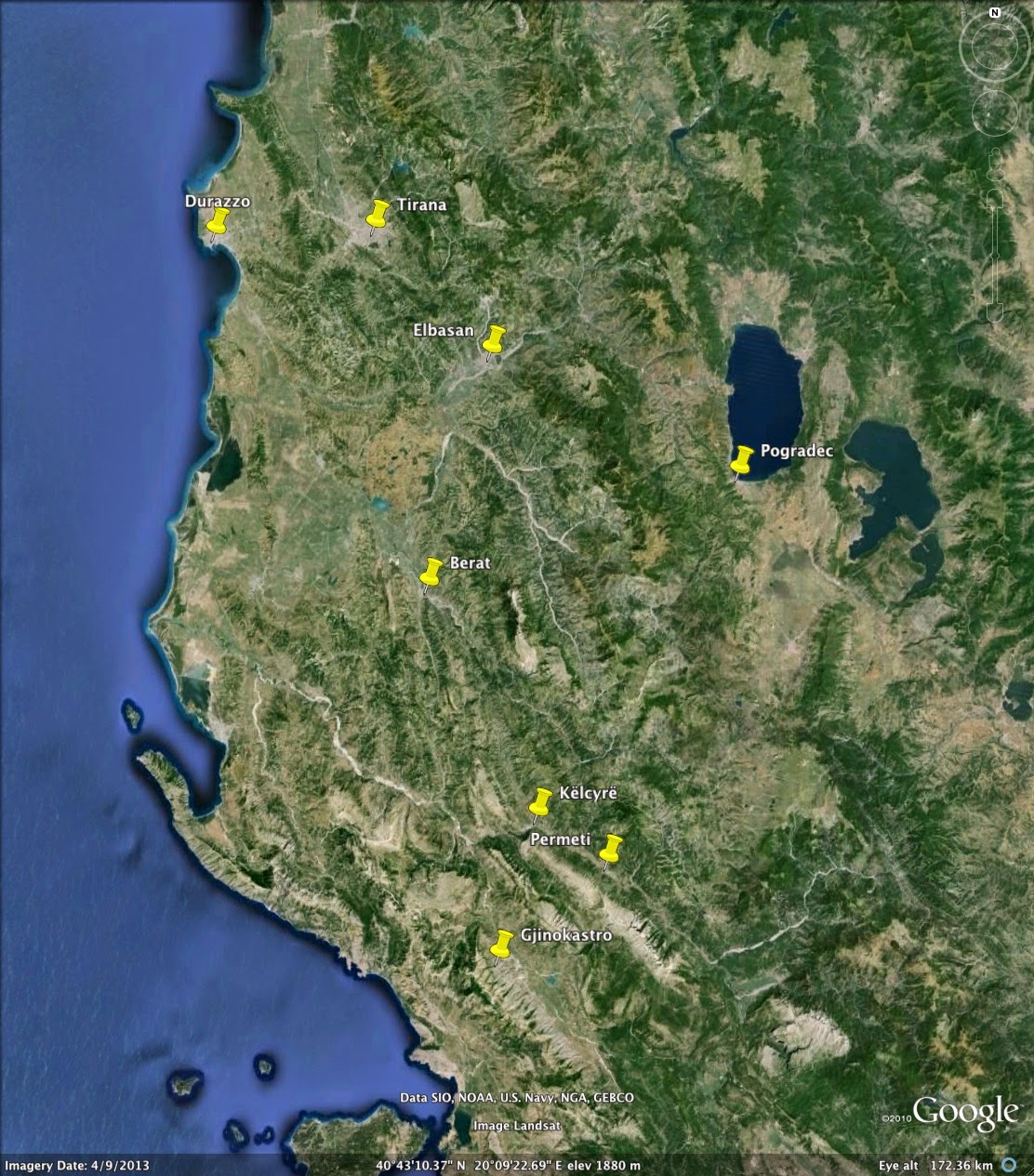
Jan and Cora Gordon visited Pogradec on the shores of Lake Ohrid on their 1925 journey. Jan had this comment to make:
'Pogradec lies at the ultimate corner of Albania, where it abuts on to the fine mountain lake of Ochrida, and it has the sorry pleasure of being able to gnash its teeth at the sight of the shining monastery of St. Naum a few miles away across the water: a pretty pearl of an orthodox monastery torn from the weak Albanian clutch by the mightier power of the Serb. We do not wish to enter here into the rights and wrongs of the case, but it appeared to us that if only the poor old saint and his monastery had been in question he might have belonged to Albania and very little would have been disputed over him, but the rumour was current that a more modern saint, St. Petroleus, lay also probably buried in his vicinity, and the Serbs would on no account give up the privilege of seeking for his place of entombment in order to raise sixty feet high shrines over his deli-quescent bones. It you want miracles, St. Petroleus is the fellow for your money; why, he makes carriages go without horses, ships without sails; and as for levitations and ascensions and all those sort of things, they are his daily business. And he cures constipation also.'
Jan Gordon's attribution of the transfer to the potential for oil exploration is perhaps not the whole story. From what I read, this is how the transfer occurred:
After the Balkan Wars of 1912 and 1913, the monastery and its surroundings were located within the newly created state of Albania. However, the Kingdom of Serbs, Croats, and Slovenes (later Yugoslavia) strongly desired the site, for its spiritual significance as a centre of Slavic learning (Naum was one of the primary developers of the early Cyrillic alphabet) and for its strategic location on Lake Ohrid. Following a period of instability in Albania, Ahmet Zogu (later King Zog I) gained power in 1924 with Yugoslav support. In repayment for that support and to resolve the border dispute, Zog agreed to cede the Monastery of Saint Naum and its surroundings to Yugoslavia. The formal transfer was completed on June 28, 1925, presented as a diplomatic, rather than military, acquisition based on "goodwill". This was the summer of the Gordons' visit.
I visited St Naum on April 2026 and found some attractive grounds and buildings in a calm lakeside setting.


'.. Pogradec, in spite of the magnificence of its situation, had not the homely pleasurable qualities of Elbasan. It lay on the Serbian border; it was touched with an odd greasy quality-ghosts of mutton fat, which haunt the Serbian. In the neighbourhood, buried amongst the Albanian country, were villages of which the inhabitants actually were of pure Serb or Bulgarian stock, still speaking their own language in their own homes. Life was heavier here, and included many American emigrants who had forfeited their right to return to America. These lent a decidedly coarse flavour to the place.'
The Gordon's had a conversation with an Italian here, which included a mention of the endemic Lake Ohrid trout:
'.. in many ways he was a fellow of excellent good-nature, but he had one odd habit - that of never being able to hear a name without adding to it all other names of a similar nature.
One would say to him, "I like Camembert cheese." "Cheese, yes," he would return eagerly, "there are good cheeses. Camembert, yes—also Gruyère, Gorgon-zola, Brie, Roquefort, Dutch, Cantal, Port Salut, Cheddar..."
Or perhaps, " Naples is a pretty town." "Naples, yes," he would reply, " but there are other beautiful places too: Rome, Siena, Florence, Milan, Assisi, Capri, Venice, Palermo ..."
One day he said to me, "There is an excellent trout in Lake Ochrida." "Trout," I replied, "yes, but other fish are good too: salmon, sturgeon, cod, whiting, mackerel, herring, whitebait...
"Jan," exclaimed Jo under her breath, horrified.
"You are right," said the little Italian to me eagerly, "and there are also sardine, red mullet, goldfish, lobster, crab, octopus, squid ..."'
I tried one of these trout for lunch in the town of Ohrid. It was delicious.
.jpeg)
References
Jan and Cora Gordon in Albania: https://pbase.com/hajar/jan_and_cora_gordon_in_the_balkans
Jan and Cora Gordon Two Vagabonds books: https://pbase.com/hajar/jan_and_cora_gordon_two_vagabond_adventures
Jan and Cora Gordon: https://pbase.com/hajar/janandcoragordon
Jan and Cora Gordon art: https://pbase.com/hajar/art_of_jan_and_cora_gordon
Comments
Post a Comment