Posts

Jan Gordon's Introduction to "...As Beggars, Tramp Through Spain"
Image
"...As Beggars, Tramp Through Spain," published in 1927 has an introduction by Jan Gordon. Gordon concludes that " Mrs. Gordon and I, travelling across Spain with our donkey-cart , thought we had come into a fairly close contact with the Spanish people, but we are ready to admit that the Count and Countess Malmignati have gone far deeper than we did. Here is a new Lazarillo de Tormes and a Beggar's Opera with song and dance complete ." Gordon observes that since the war, the " newly-admitted pluck of women has been turned to exploration, and women travellers have shown themselves the equal of men in daring resourcefulness and energy, astonishing to the wild peoples amongst whom they have travelled ." He notes the attempted journey to reach the " Ruba-El-Kali " in 1914 (which was commented upon in 1926 by the explorer H. St. J. B. Philby ), the story of which was published by the countess in 1925 as "Across the Inner Desert...

Jan and Cora Gordon, Guitars in London

Image
Jan and Cora Gordon were fascinated by guitars, lutes and other stringed musical instruments. This interest was indulged during their 1920 visit to southern Spain (see: Guitars in Spain  and " Poor Folk in Spain "), where they learned to play the instruments. The story of a very unusual guitar given to them on that first journey is told here: Jan and Cora Gordon in Spain . Jan and Cora Gordon with their instruments, from the catalogue of their exhibition at London's Twenty One Gallery, which began on February 11th 1931. In 1931 the Gordons were in London for an exhibition at the Twenty One Gallery . Ashley Smith bought one of Jan Gordon's paintings, probably " New Forest Glade ," priced at 16 guineas and later given to his son for his birthday . The Gordons played a concert at the house of Doris and Ashley Smith and were reunited with an old acquaintance, Gluck (Hannah Gluckstein). My father, then a small child, listened to the gu...

Jan and Cora Gordon, A 1922 First Edition Cover

Image
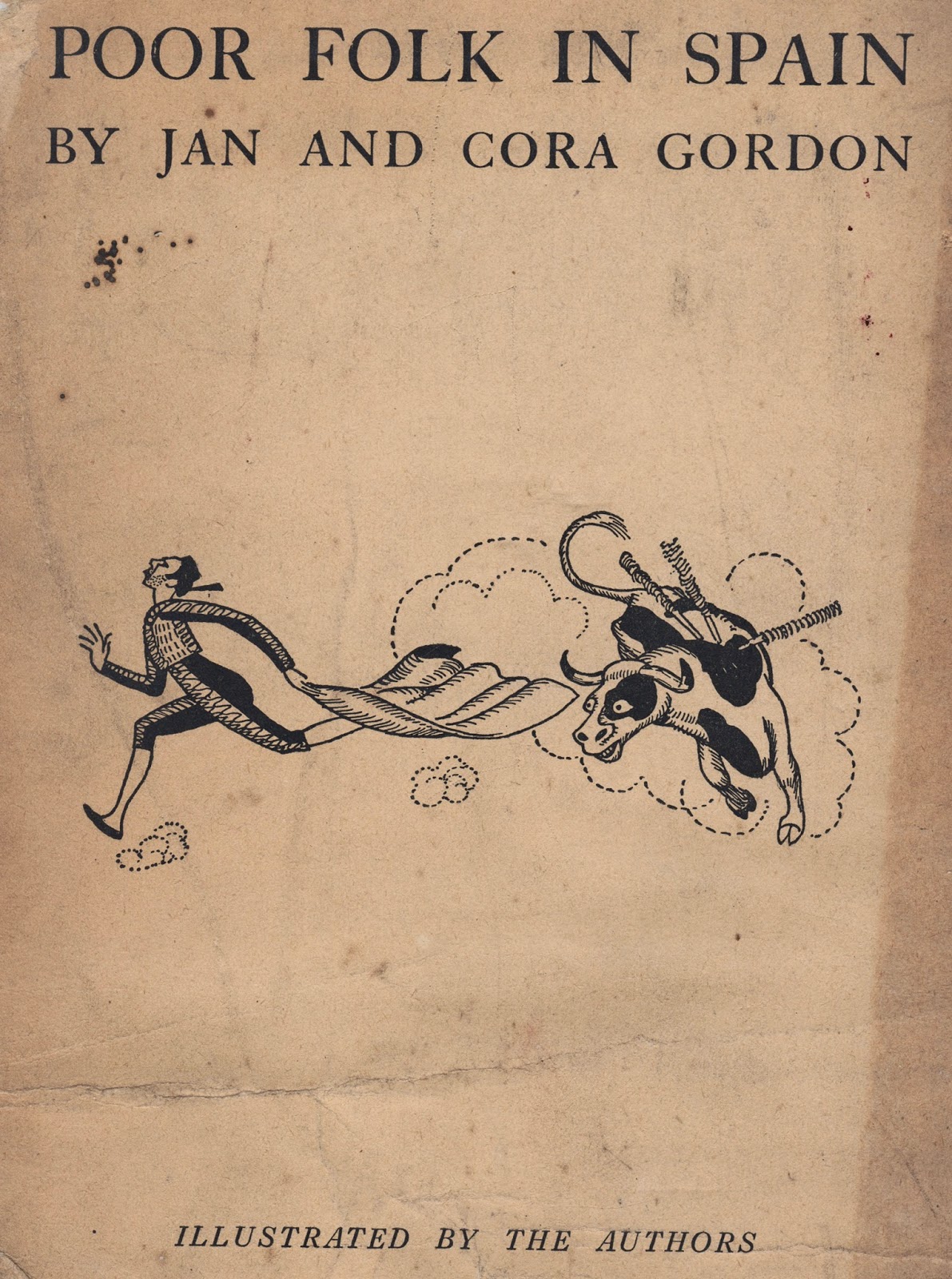
The Gordons visited Spain in 1920, exhibiting paintings from the journey in early 1921 at the Burlington galleries and publishing " Poor Folk in Spain " in 1922. The dust jacket of the first edition has a delightfully simple design, showing a torero running from an enraged bull. Here it is: The book was republished for American audiences, by Robert M. McBride & Co in 1923, as "Two Vagabonds in Spain" and the enjoyable dust cover for that edition is adorned with extracts from the numerous drawings that illustrate the book, including the running torero. The image represents the "taunting of the unwilling bull" in a Murcian bullfight (pg 101). " The toreros flapped their faded cloaks at it, but whenever the bull was tempted to charge the man ran for safety and crammed himself through one of the bolt-holes in the palisade ."

Reviews of Jan Gordon's "A Girl in the Art Class"

The Observer (1927, March 6th) published a review of "A Girl in the Art Class" (Hutchinson, 7s. 6d.) under the title "An Artist's Novel," noting how the author's knowledge of art adds to the sense of authenticity. Other reviews made the same observation and included the following. " Jan Gordon's story has all the stamp of the real thing. A clever presentation of an instinct-personality. Raymonde Carpenter gives some delicious little sketches of her fellow students and their eccentricities. They strike one as having been done from life ." Evening Standard. " Vivid and veracious story. The standards of morality freely set forth will be amazing to the respectable ... nearly all have free views of sex " - English Review " This book strikes one as a very true picture of the Artist life .... You can hear all Jan Gordon's characters talking ." - The Queen. " The studio life in Paris is written by one who knows it ...

Jan and Cora Gordon: Mediterranean Impressions in Majorca

Image
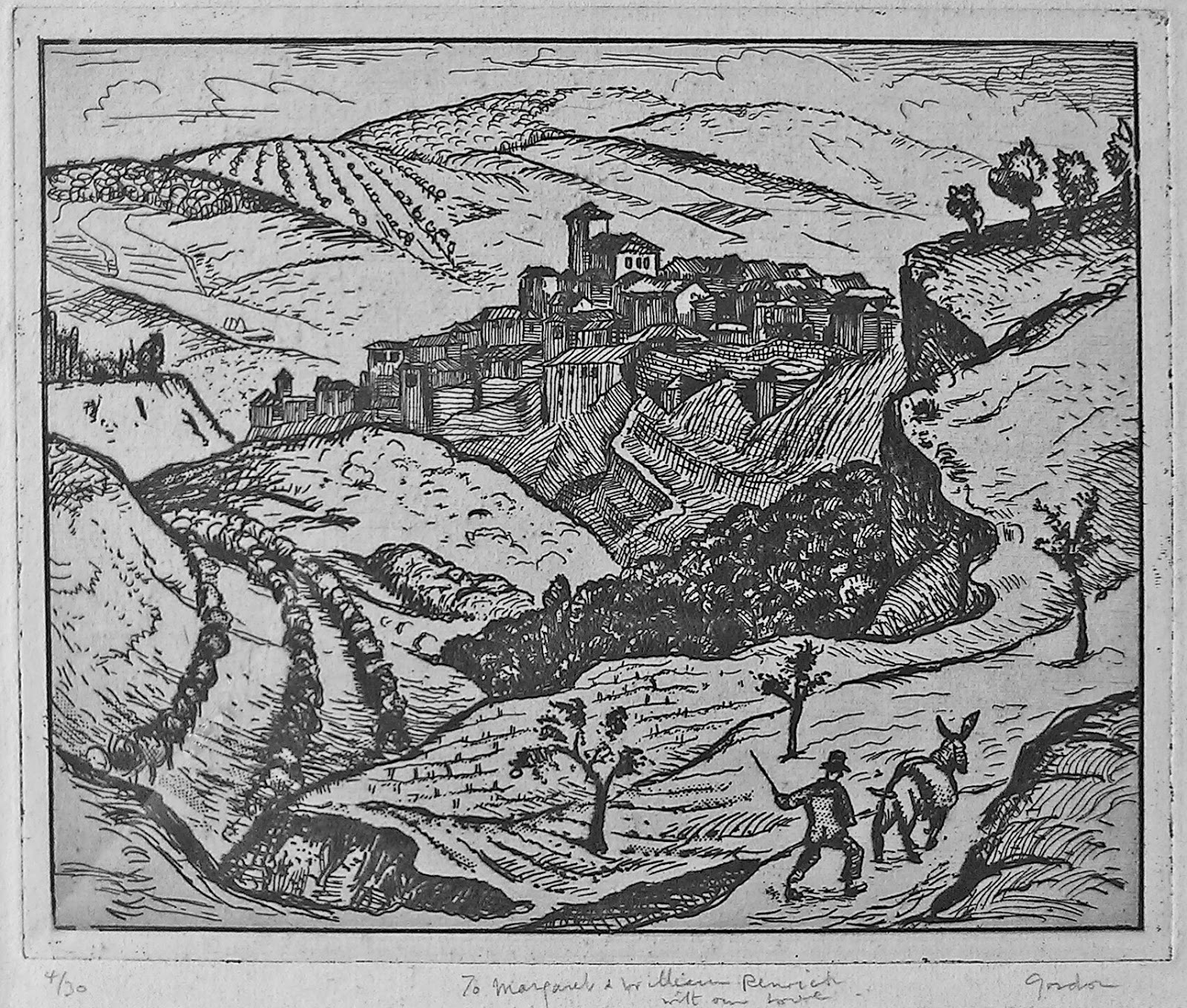
A review (by Jean Silvin) of a show by Jan and Cora Gordon in Paris during December 1913 at the Galerie Henri Manuel praised Jan Gordon's Mediterranean impressions, as follows, " Ses impressions méditerranéennes, par la richesse du couleur, le movement, l’atmosphère, le brio de facture et la limpidité des gris et des bleus légers nous permettent de donner à cet artiste toute notre sincère sympathie. ” Cora Gordon (1950) described how they lived in Majorca for three months, " living on grapes, figs, rice and the golden fish that abounded in the incredibly blue sea ." " For the first few days we wandered round - falling more and more in love with the character of the place, sometimes scribbling possible compositions in minute sketch books. Without hesitation or erasure Jan could, in a four-inch sketch book, set down panoramas of mountains, olive groves, or perhaps whole towns seen from an altitude ." A town in Majorca, ca 1913, etching by Jan Go...

Cora Gordon on "The Artist as a Traveller" 1950

ANTHONY HUXLEY, writing in The Spectator of December 29th, 1950, discussed a compilation of essays, "Traveller's Quest" (William Hodge). " Some of the essays have turned into rather discursive and auto- biographical reminiscences, not all of which are very satisfying. But many retain their interest despite condensation, such as Alec Waugh's rendering of Russia in 1934 (all too like 1984 even then), or Cora Gordon's evocation of a night of noxious smells in Dalmatia. This is a digressive book, admirable for the armchair traveller, and a book also of natural philosophy, of the determination of individuals not only against physical obstacles but against the almost irresistible force of the collective. A change from the usual collection of travellers' tales. " Cora Gordon's chapter in the book serves as a wonderful epitaph for the lives the Gordons lived. It begins with, " The artist is a privileged traveller, for his is the only quest th...

Jan and Cora Gordon with Luise and Heinrich Fürmann in pre-WW1 Munich

Jan and Cora Gordon remembered their pre-WW1 time in Munich upon meeting, in 1927, a tattoed German performer at Coney Island . Cora Gordon much later (1950) wrote about those days as follows, " The Pension Fürmann was then famous as the abode of the liveliest and most impoverished students, sub-editors, teachers and cranks of the city [Dering 1998] . Fürmann, a fatherly man with a kind eye and a formidable chin, had in his youth emigrated to America. On returning he inherited a small farm situated in the bohemian and formerly outlying part of the town. He added to the building and for three marks (2s. 6d.) a day you got a room and excellent board with high jinks and dancing on Saturday evenings. Once a month we paid two marks each towards the fee of a little peasant dance orchestra and also enjoyed a barrel of beer in the kitchen ." " Those monthly balls were treated by us as great occasions for which we designed fancy dresses and made quite elaborate decoration...