Posts

Jan and Cora Gordon: 1939 Biographical Notes

Image
The 1939 Penguin edition of "Two Vagabonds in Serbia and Montenegro" by Jan and Cora Gordon , a reprint of the 1916 " The Luck of Thirtee n", has an informative little biographical introduction to the Gordons. Cora and Jan Gordon with guitar and laud. It reads as follows: "These two writers are unique in the general likeness of their abilities and temperaments. Cora J. Gordon compelled her father to allow her to study art by threatening to take up the stage, on which she had been offered a promising start. After a Slade training she took the L.R.A.M. examination in music. Returning to painting she went to Paris, and exhibited her work. In 1909 she married Jan Gordon, ex-mining engineer , who also has exhibited in many important collections, and was an expert banjo player. Subsequently Jan was a designer of naval camouflage and painted a number of pictures on naval medical work , some of which are in the War Museum and some in the Burroughs Wellcome ...
Jan and Cora Gordon: Portraits by Howard Coster and Madame Yevonde

Image
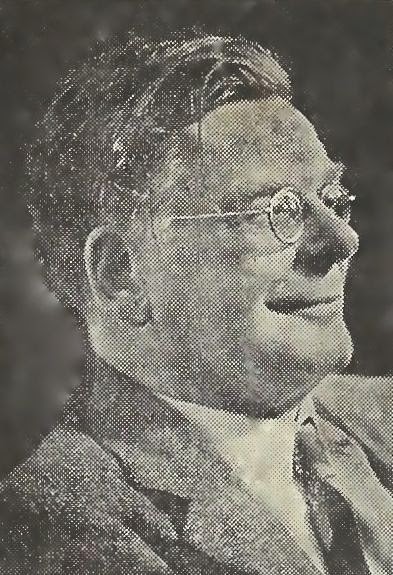
A number of photographic portraits of Jan and Cora Gordon exist, typically posed with their Spanish instruments . There are also two individual portraits which were made by well known photographers of the 1920s and 1930s, these being Howard Coster and Madame Yevande. Jan Gordon by Howard Coster Howard Coster (1885 - 1959) was a successful London photographer who specialised in photographic portraits of men. He opened a studio at 8 and 9 Essex Street, London in 1925. His most iconic image was of A. A. Milne with his son Christopher Robin Milne and Pooh Bear, at Cotchford Farm, Sussex. Cora Gordon by Madame Yevande Madame Yevande was the professional name of Yevande Cumbers Middleton (1893 - 1975). She had joined the suffragette movement in 1910. After a three year apprenticeship with Lallie Charles she set up her own studio at 92 Victoria Street, London, at the age of 21. She is remembered for developing colour portrait photography in the 1930s. The a...

Cora J. Gordon: Sketching in Hyde Park

Image
In " A Step-ladder to Painting "(1934) by Jan Gordon can be found a section on "The Fountain Pen." "For many years Cora Gordon has made a habit of using the meetings at Hyde Park as a most profitable ground for character sketching." This forms the subject for a chapter in " The London Roundabout " (1933). Pen sketches by Cora J. Gordon ( Step-ladder to Painting ) of characters in Hyde Park, London "It is splendid fun but can also be very hard work. After three or four hours of intensive sketching in the Park, Mrs. Gordon often comes home quite exhausted. In that time she might have drawn perhaps a hundred heads, at least thirty of which will be brilliant summaries of character likeness." I remember hearing this story as a youth, with an emphasis on drawing directly in ink: "If you can't correct you are bound to observe with precision."

Jan Gordon: "No New Shocks" Prophecy in 1923

Image
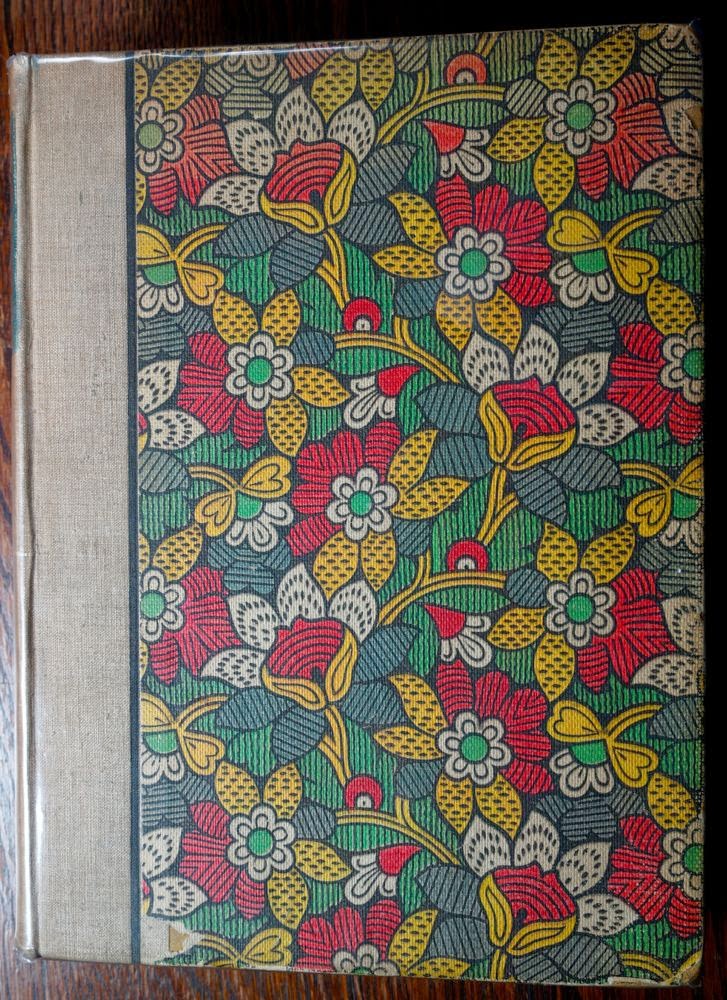
In the revised edition of " Modern French Painters " (1936), Jan Gordon writes, "When the editors suggested a new printing the question arose whether any serious revision of the text was necessary. But on page 174 I had ventured to prophecy that, 'The public may expect no new shocks for a very long while.' .... I am pleased to say that in the interval, allowing for the intention and the limits of the book, no considerable alteration is needed." This quote links to an article written by Jan Gordon for the Pittsburgh Post Gazette in 1927 that I wrote about in February 2013 . I went back to the 1923 first edition, which has a very colourful cover, shown below: Cover of the 1923 first edition of "Modern French Painters.  This copy has a   dedication to artist Steven Spurrier . .. and turned to page 174 to find that the above prophecy was not there, on the very last page of the book. It is, however, on the preceding page, as follows: ...

"Dazzle-Painting in War-Time"

Image
A 1919 edition of "The Studio" has an article by Hugh Hurst on "Dazzle-Painting in War-Time." These are the dazzle designs for ships developed by Jan Gordon , Steven Spurrier and others and discussed in Gordon (1918) . He writes, "To the lover of the ship for the ship's sake the appearance of our docks in the great ports during the war may perhaps have come as somewhat of a shock, but to the artist the transformation from a monotonous uniformity to a scene presenting a pageant-like array of strong colour and strange designs this change can have been nothing but a joy." Paintings by LIEUT. L. Campbell Taylor R.N.V.R. and LIEUT. Guy Kortright, R.N.V.R. illustrate some of the "dazzled" ship designs. S.S. Minnedosa at Liverpool after disembarking American troops.  Water colour by Guy Kortright, R.N.V.R. H.M.T. Mauretania entering half-tide dock at Liverpool.  Water colour by L. Campbell Taylor R.N.V.R.   Dazzled...

Jan Gordon and Steven Spurrier: "The Purest Art. Dazzle."

Image
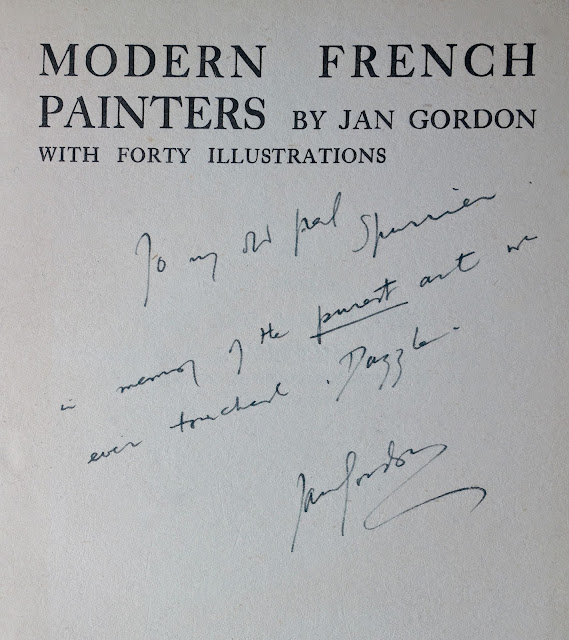
A copy of " Modern French Painters " (1923) in my library, once in the possession of the artist Steven Spurrier (1873-1961), has the following dedication from  Jan Gordon : "To my old pal Spurrier        in memory of the purest art we ever touched. Dazzle.                                                                                                                                              Jan Gordon" This is a wonderfully evocative connection with the story of the dazzle-painted ships of WW1, in which both  Jan Gordon  and  Steven Spurrier  were involved. In " The London...

Jan Gordon: "Some Sketching Tips" in "The Artist" 1934

Image
In " The London Roundabout " (1933) by  Jan and Cora Gordon , a monthly magazine called "The Artist" is held up as an example of the "home interests" of the Englishman. "This magazine, beautifully produced and costing two shillings, is published solely to give instruction in the various branches of painting and the allied arts. On its inception by a shrewd Northerner expert opinion predicted that the magazine could not last six months. Smith's bookstalls, which handle a full half of the British paper and magazine trade, agreed to take four thousand copies, a half of the first issue, on sale or return, but candidly told the editor that they did not expect to sell two hundred and fifty copies. Within a week they were Oliver Twisting, with a similar fate. The first number was sold out in ten days, and a copy of The Artist, vol. i, No. I, is now to be bought only at a large premium, ten times the original value or there abouts. The circulation is s...